Why AI Test Generation Isn't Magic (And What It Actually Does)

AI test generation does not write your entire test suite for you. Here is what it actually does, where it works, where it falls short, and how QA teams use it in practice.
Quick Answer
AI test generation uses machine learning models to suggest, draft, or scaffold test cases based on requirements, code, or existing test patterns. It is not a replacement for human testers. It is a productivity tool that handles repetitive, pattern-based work so SDETs and QA engineers can focus on edge cases, exploratory testing, and test strategy. The teams getting real value from it treat it as an assistant, not an autopilot.
Top 3 Key Takeaways
- AI test generation is pattern recognition, not creative thinking. It excels at generating repetitive test structures from known patterns but struggles with novel edge cases and business context that require human judgment.
- The biggest wins come from reducing grunt work, not replacing testers. Teams using AI generation report saving 3-6 hours per week on boilerplate test creation, freeing time for higher-value testing activities.
- Adoption varies widely by role and company size. Individual SDETs and small startups adopt quickly, while large enterprises move slower due to security reviews, compliance requirements, and integration complexity.
TL;DR
AI test generation tools analyze your requirements, code, or existing tests and produce draft test cases. Good at boilerplate and pattern replication. Bad at business context and novel edge cases. The teams that succeed use it for first drafts, then apply human review. This post covers how it works, who is adopting it, and where the hype outpaces reality.
Introduction
If you have been near QA Twitter, LinkedIn, or a testing conference recently, you have heard the pitch: AI will generate your test cases for you. Just point it at your application and watch the tests write themselves.
I work as an SDET. I have used multiple AI test generation tools. That pitch is about 30% accurate and 70% marketing.
That is not a criticism. The 30% that works is genuinely useful. But the gap between what people think AI test generation does and what it actually does causes real disappointment if you go in with wrong expectations. This post is the honest breakdown from a practitioner.
What AI Test Generation Actually Does
At its core, AI test generation is pattern matching at scale. Most tools work in one of three ways:
- Requirement-based generation. You feed in a user story or spec. The model produces test case outlines covering the described scenarios.
- Code-based generation. The tool analyzes source code -- function signatures, API endpoints, data models -- and generates test scaffolds.
- Pattern-based generation. The tool learns your existing test suite's conventions and generates new tests following the same patterns.
Each approach has strengths. None of them understands your business.
What It Handles Well (And What It Does Not)
| Task | AI Performance | Why |
| Boundary value test cases | Strong | Pattern-based, rule-driven |
| CRUD operation test scaffolds | Strong | Highly repetitive structure |
| Negative test cases from specs | Moderate | Can miss context-specific negatives |
| Data-driven test variations | Strong | Combinatorial expansion is mechanical |
| API contract tests from schemas | Strong | Schema-to-test is well-defined |
| Exploratory test scenarios | Weak | Requires domain knowledge and creativity |
| Complex E2E workflow tests | Weak | Needs business context AI lacks |
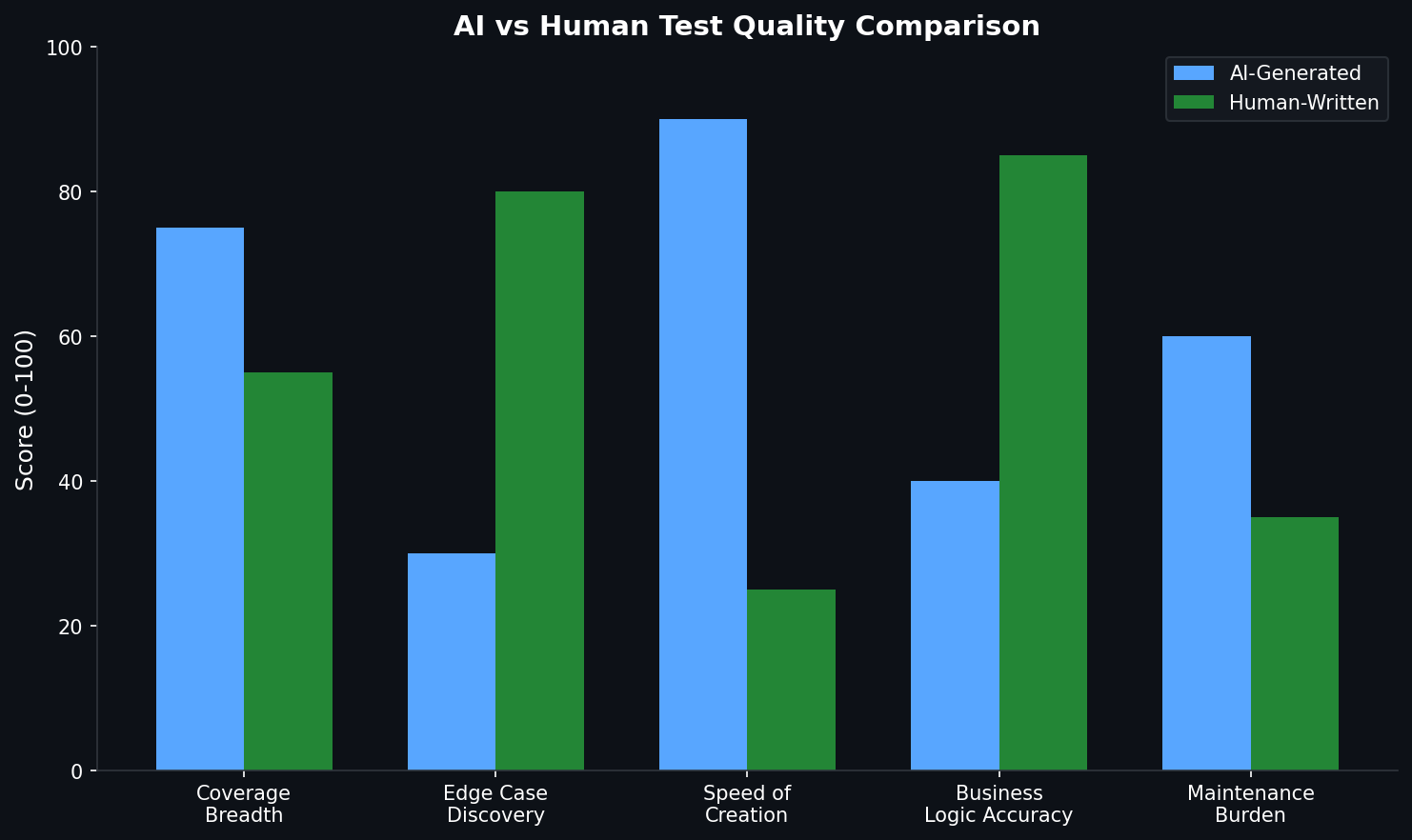
The pattern is clear. The more repetitive the task, the better AI handles it. The more it requires human judgment, the worse it performs.
Why the Hype Oversells It
Demos are curated. Every AI test generation demo uses a clean, well-documented API. Real codebases have legacy endpoints with no documentation and implicit business rules buried in code comments.
"Generated" does not mean "ready to run." AI-generated tests need 40-60% modification before they are production-ready. Assertions are often too shallow. Setup and teardown steps are frequently missing.
Accuracy metrics are misleading. When a vendor says "90% accuracy," ask what that means. Does 90% compile? Low bar. Does 90% catch real bugs? I have never seen that claim substantiated independently.
Who Is Adopting AI Test Generation (And How)
Adoption depends heavily on role, team size, and company maturity.
Adoption by Role and Company Size
| Role | Small Company (1-50) | Mid-size (51-500) | Enterprise (500+) |
| Individual SDET | High | Moderate | Low |
| QA Lead / Manager | Moderate | Moderate | Low to Moderate |
| Manual Tester | Low | Low to Moderate | Low |
| Dev writing own tests | High | High | Moderate |
Small teams adopt faster because there are fewer gates. Enterprises move slower due to security reviews, data governance, and procurement cycles.
Adoption Distribution (Pie Chart Data)
Fallback table:
| Adoption Stage | Percentage |
| Using actively in workflow | 18% |
| Piloting or evaluating | 24% |
| Aware but not using | 33% |
| Not aware or not interested | 25% |
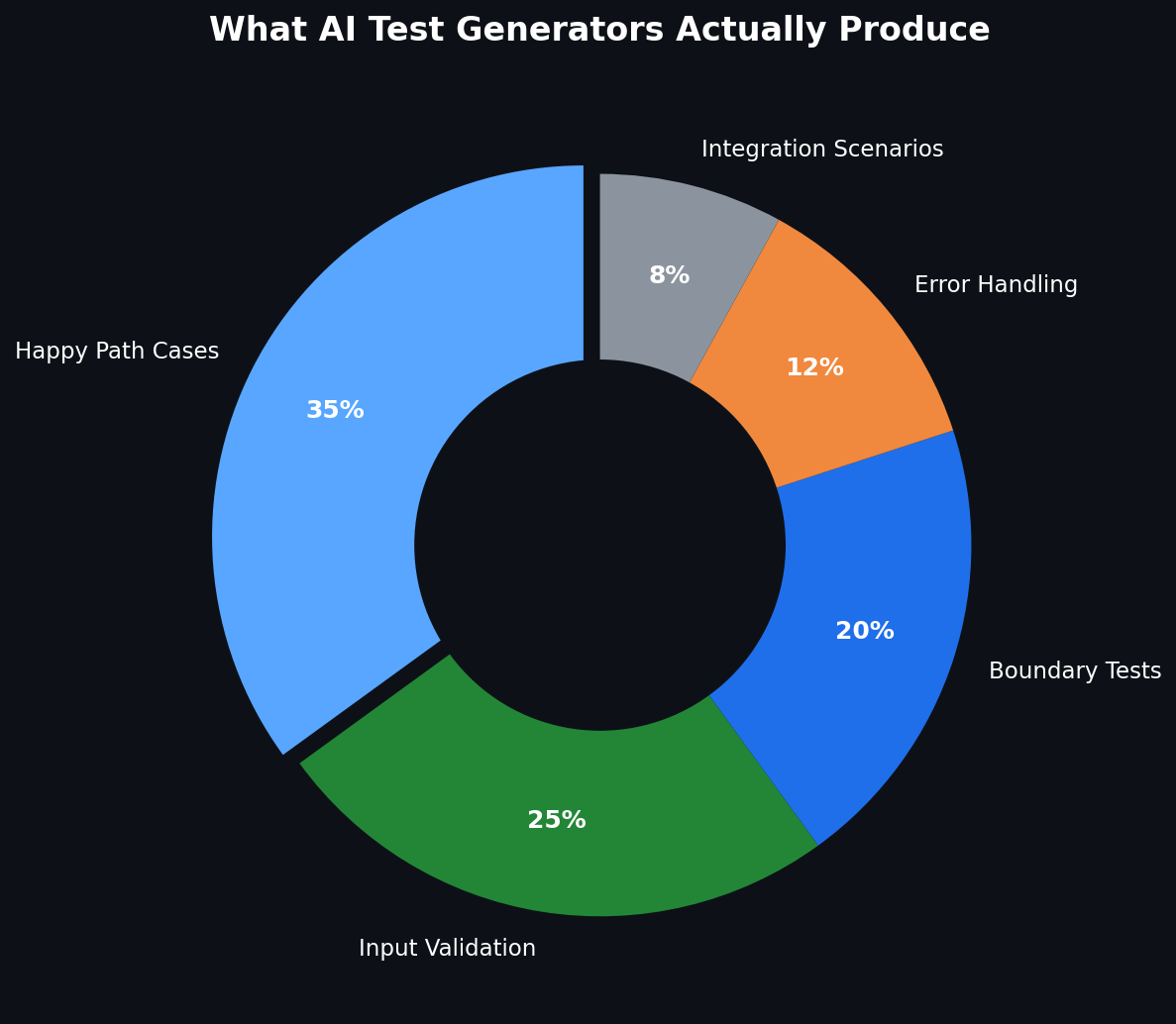
Note: Illustrative estimates based on industry trends from the Capgemini World Quality Report 2023-24 and similar QA surveys.
How Teams Are Actually Using It
The teams getting real value use AI generation surgically for specific, well-bounded tasks. Here is the workflow that works:
- Write the requirement clearly. Garbage in, garbage out applies strongly here.
- Run AI generation for a first draft. Get a skeleton -- test names, basic steps, obvious positive and negative paths.
- Human review and enrichment. Add business-specific edge cases, fix assertions, add proper test data setup.
- Integrate into your test management system. Tag, link to requirements, and track execution history.
Step 3 is non-negotiable. I have watched teams skip it and end up with 500 tests that catch zero real bugs.
Time Savings Comparison
| Activity | Without AI | With AI | Time Saved |
| API endpoint test scaffolding | 2-3 hours | 30-45 min | ~60% |
| Boundary value tests | 1-2 hours | 15-20 min | ~75% |
| Data-driven test variations | 1.5-2.5 hours | 20-30 min | ~70% |
| Complex E2E workflow tests | 3-5 hours | 2.5-4.5 hours | ~10-15% |
| Exploratory test ideation | 1-2 hours | 1-2 hours | ~0% |
AI generation saves significant time on structured, repetitive tasks and almost none on creative or domain-specific work.
Expert Analysis
Here are the patterns that separate successful adoption from shelfware.
Successful teams set clear boundaries. They define exactly which test types AI generates (boundary values, CRUD scaffolds, data variations) and which remain human-authored (complex workflows, security tests, exploratory scenarios).
Successful teams invest in input quality. Well-written requirements with clear acceptance criteria produce dramatically better AI output than vague user stories. Teams that improved their requirements documentation first saw 2-3x better generation quality.
Failed adoptions share a common mistake. They treat AI generation as a headcount reduction tool instead of a productivity multiplier. The team that keeps their testers and gives them AI tools ends up with better coverage and faster cycles.
From observations across QA teams -- including work at TestKase around test management workflows -- organizations seeing real ROI integrate AI generation into a structured review process rather than treating it as a standalone solution.
FAQ
Q: Can AI test generation replace manual testers? A: No. It handles repetitive test case creation but cannot replace the judgment and exploratory instincts experienced testers bring.
Q: How much time does it actually save? A: For boundary values and CRUD scaffolding, expect 50-75% savings. For complex workflows, savings are minimal. Net across a week, most SDETs save 3-6 hours.
Q: What is the biggest risk of skipping review? A: Shallow assertions. AI tests often check that something happened without verifying the right thing happened. A test asserting a 200 status code without checking the response body gives false confidence.
Q: Do I need to change my test management process? A: Add a "generated -- needs review" status to your workflow. This prevents unreviewed tests from entering your active suite.
Q: Which testing types benefit most? A: API contract testing, boundary value analysis, and data-driven test creation see the highest returns. Performance, security, and usability testing see almost no benefit.
Actionable Recommendations
For SDETs and QA Engineers
- Start with API tests. They have the clearest input and most predictable output. Good for calibrating expectations.
- Never skip the review step. Budget 30-40% of time saved for reviewing assertions and adding missed edge cases.
- Track quality, not quantity. Measure how many AI-generated tests catch real bugs. If close to zero, fix your assertions.
- Feed better inputs. Spend 15 minutes improving your spec before generating. The output difference is dramatic.
For QA Leads and Engineering Managers
- Run a bounded pilot. Pick one API. Use AI generation for two sprints. Measure time saved and bugs caught.
- Reallocate, do not reduce. Move saved time to exploratory testing and coverage gap analysis.
- Invest in requirements quality. The highest-ROI action is writing clearer requirements, not buying a better tool.
- Set up a review workflow. Draft, review, approved, integrated. Without this, unreviewed tests will clutter your suite.
Conclusion
AI test generation is not magic. It is a productivity tool that handles the mechanical, pattern-based parts of test creation well. It generates boundary values faster than you can type them. It scaffolds CRUD tests in seconds. It produces data-driven variations without copy-paste fatigue.
But it does not understand your business. It does not write meaningful assertions without human guidance. And it does not replace the judgment experienced testers bring to exploratory testing.
The teams getting real value treat AI generation the way a good writer treats a spell checker: useful, time-saving, and not a substitute for thinking. Use it for first drafts. Review everything. Invest in your inputs. The 30% it handles well is enough to make a real difference in your week -- if you use it right.
About the Author
Naina Garg is an AI-Driven SDET at TestKase, an AI-powered test management platform. She writes about AI in quality engineering, test automation, and the gap between testing tool promises and day-to-day practitioner reality.


