API Testing Beyond Status Codes: What Your Tests Are Missing

Quick Answer
Most API test suites check the HTTP status code and stop there. A 200 response does not mean the API behaved correctly — it means the server did not crash. Proper API testing validates response structure, data accuracy, performance boundaries, error handling, and contract compliance. If your API tests only assert on status codes, you are testing whether the server is alive, not whether it works.
Top 3 Key Takeaways
- A 200 status code tells you almost nothing. The response could return the wrong data, miss required fields, or take 12 seconds. Status-only tests catch crashes, not bugs.
- Schema validation catches more regressions than status checks. When a field changes type, gets renamed, or disappears, schema tests catch it immediately. Status code tests do not notice.
- API contract testing prevents integration failures. If your API serves multiple consumers (web, mobile, third-party), contract tests ensure changes do not break downstream clients.
TL;DR
API testing that only checks status codes is like code review that only checks if the code compiles. You need to validate response schemas, data correctness, performance boundaries, error payloads, and backward compatibility. Teams that test APIs properly catch 3-5x more regressions than teams that stop at "200 OK." This post covers what to test, how to structure it, and where most teams fall short.
Introduction
A payments team shipped an API update on a Thursday. All tests passed — 200 status codes across the board. Friday morning, the mobile team filed an urgent bug: the checkout flow was broken.
The cause? A response field called total_amount had been renamed to totalAmount — camelCase instead of snake_case. The API still returned 200. The status code tests still passed. But every mobile client parsing that field broke silently.
One renamed field. Zero test failures. Millions in failed transactions.
This is what happens when API testing stops at the status code. The server is working. The API is broken. And your tests cannot tell the difference.
What Status Code Tests Actually Cover
Let us be precise about what a status code assertion tests:
| What It Catches | What It Misses |
| Server errors (500) | Wrong data in a 200 response |
| Missing endpoints (404) | Missing or renamed fields |
| Auth failures (401/403) | Incorrect data types |
| Method not allowed (405) | Performance degradation |
| Rate limiting (429) | Pagination breaking changes |
| Server timeouts | Response size anomalies |
Status code tests are a floor, not a ceiling. They catch catastrophic failures — the server is down, the route does not exist, authentication is broken. They miss every bug where the server technically responds but responds incorrectly.
The Six Layers of API Testing
Layer 1 — Status Code (What Most Teams Do)
Assert the expected HTTP status for each endpoint and method. This is table stakes.
// Minimum viable API test
expect(response.status).toBe(200);
Layer 2 — Response Schema Validation
Validate that the response body matches a defined structure — correct fields, correct types, required versus optional.
// Schema validation catches structural regressions
expect(response.body).toMatchSchema({
  id: { type: 'string', required: true },
  email: { type: 'string', format: 'email', required: true },
  created_at: { type: 'string', format: 'date-time', required: true },
  plan: { type: 'string', enum: ['free', 'pro', 'enterprise'] },
});
This is the layer that would have caught the total_amount to totalAmount rename. Schema tests are the highest-ROI investment after basic status checks.
Layer 3 — Data Accuracy
Verify that the response contains correct data, not just correctly shaped data.
- Create a user, fetch the user, verify the fields match what you sent.
- Update a resource, verify the update is reflected in subsequent GET requests.
- Delete a resource, verify it no longer appears in list endpoints.
Layer 4 — Error Response Validation
When something goes wrong, does the API communicate the error clearly?
- Do validation errors return 400 with specific field-level messages?
- Does a missing resource return 404 with a meaningful body (not an HTML error page)?
- Are error response structures consistent across all endpoints?
Bad error handling is one of the most common complaints from API consumers — and one of the least tested areas.
Layer 5 — Performance Boundaries
API tests should assert on latency, not just correctness.
// Performance boundary
expect(response.time).toBeLessThan(500); // ms
A response that is correct but takes 8 seconds is a bug for any real-time consumer. Set latency thresholds per endpoint based on SLAs.
Layer 6 — Contract Compliance
If your API has consumers (frontend, mobile, third-party), contract tests verify that the API still satisfies each consumer's expectations after a change.
Contract tests sit between unit tests and E2E tests. They are fast to run and catch breaking changes before deployment.
Who Gets Hit by Shallow API Testing
By Role
| Role | Impact of Shallow Testing | What They Need |
| Backend Developer | Renames a field, no test fails, breaks consumers | Schema + contract tests in CI |
| Frontend Developer | Discovers API changes at runtime, not test time | Consumer-driven contracts |
| Mobile Developer | Finds breaking changes after app store submission | Versioned API contracts |
| QA / SDET | Spends time debugging integration issues, not preventing them | Layered API test strategy |
| API Product Manager | Breaking changes erode partner trust | Backward compatibility checks |
By API Type
| API Type | Minimum Test Layers | Why |
| Internal (team-owned) | Status + Schema + Data | Catches regressions between sprints |
| Cross-team (shared services) | All layers including contracts | Multiple consumers with different expectations |
| Public / Partner | All layers + versioning tests | Breaking changes have external consequences |
| Third-party (consumed) | Schema + contract stubs | Detect upstream changes before they break you |
Where API Testing Effort Should Go
Recommended distribution of API testing effort:
| Testing Layer | Recommended Effort Share |
| Schema Validation | 30% |
| Data Accuracy | 25% |
| Error Handling & Edge Cases | 20% |
| Contract Compliance | 15% |
| Status Code Checks | 5% |
| Performance Boundaries | 5% |
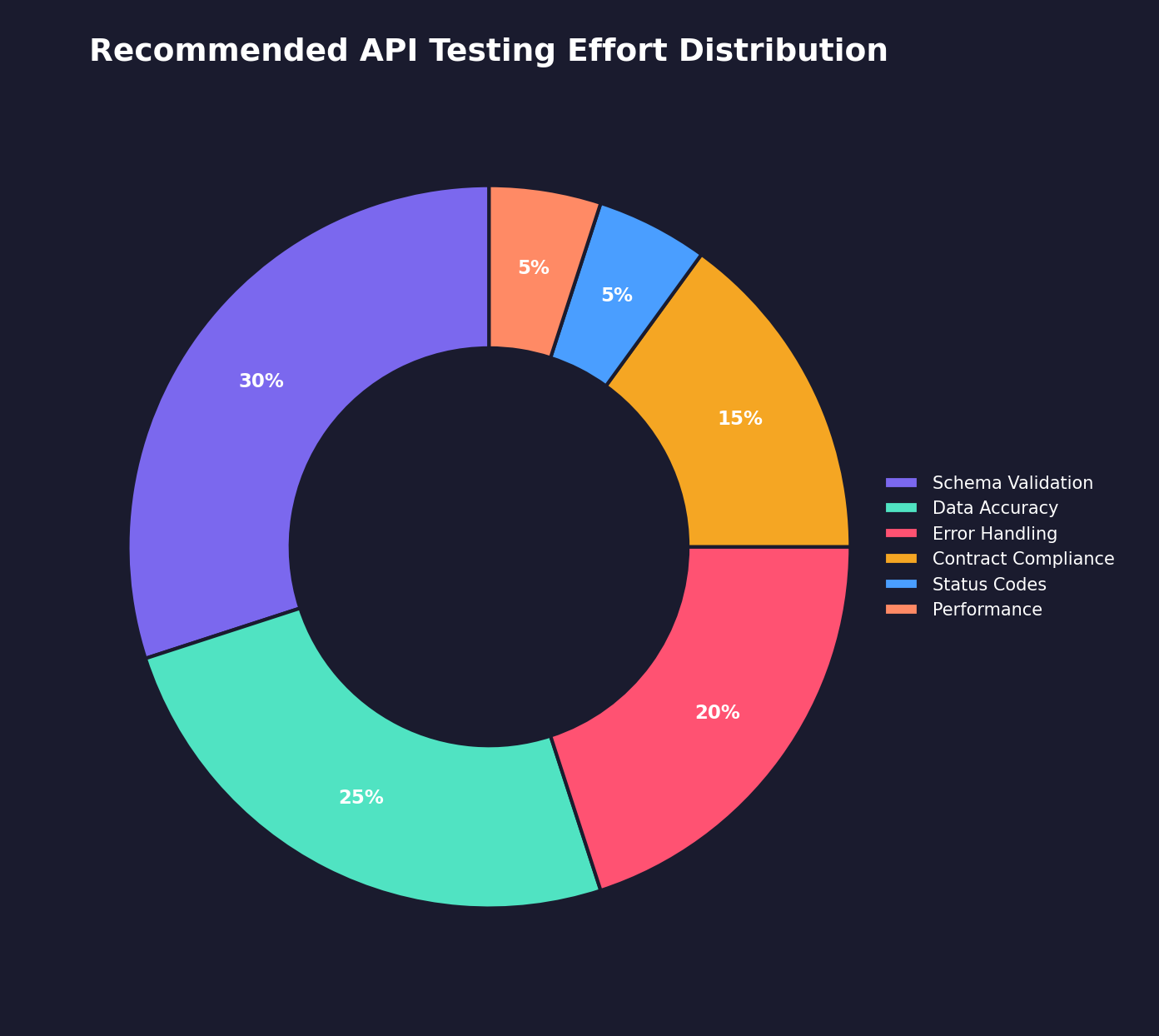
Status codes should be the smallest investment — they are binary (pass/fail) and easy to write. Schema and data accuracy are where most bugs live and where effort should concentrate.
Comparison: Shallow vs. Deep API Testing
| Dimension | Status-Code-Only | Layered API Testing |
| Breaking change detection | Catches crashes only | Catches structural, data, and behavioral regressions |
| Time to write per test | 2-5 minutes | 10-20 minutes |
| Bugs caught per test | ~0.1 | ~0.8-1.2 |
| Consumer trust | Low — changes break clients | High — contracts prevent surprises |
| Regression confidence | Minimal | High |
| Maintenance cost | Low but misleading | Moderate and worthwhile |
| CI run time impact | Negligible | Adds 1-3 minutes (schema + contract validation) |
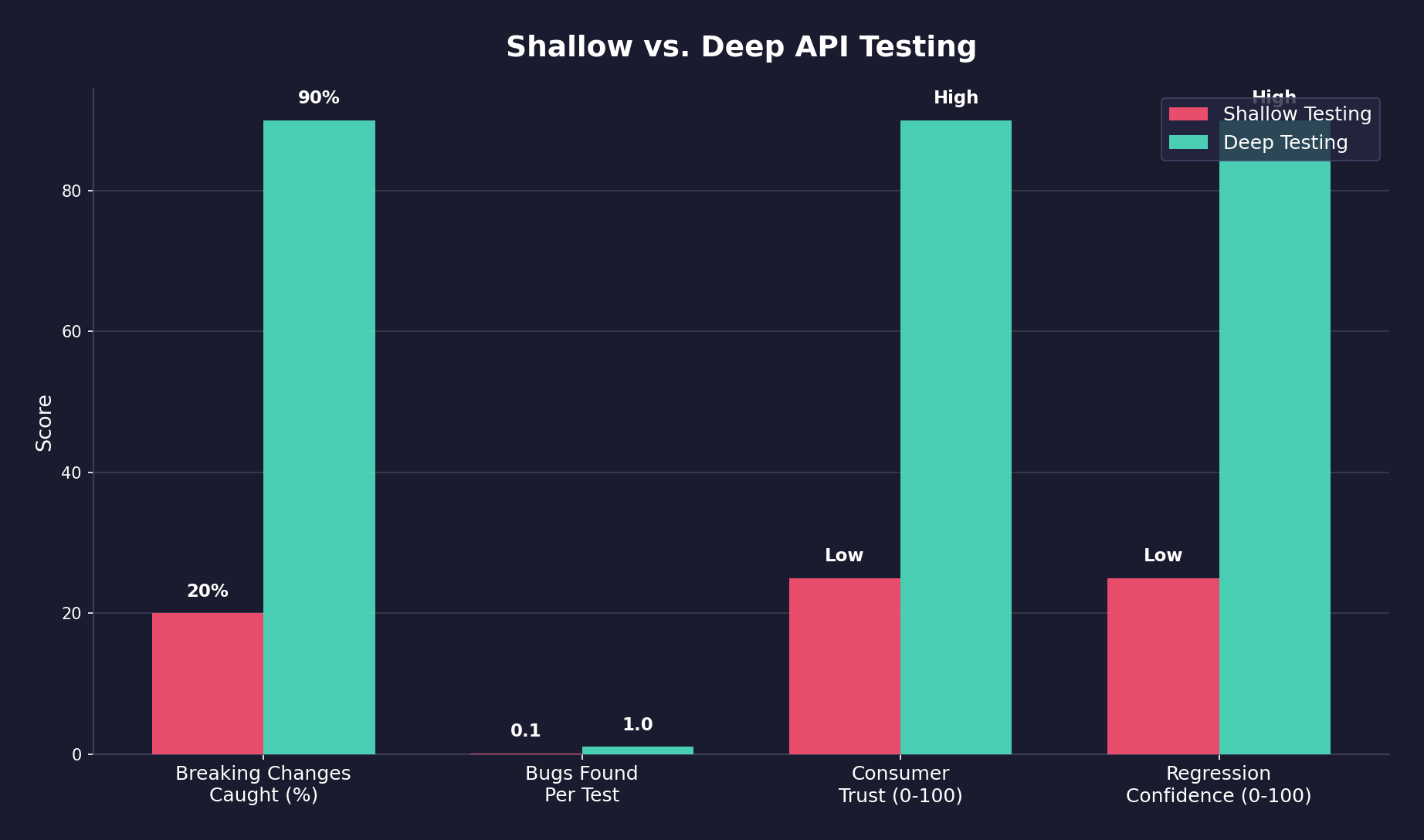
The extra 10 minutes per test pays for itself the first time a schema test catches a renamed field before it reaches production.
Expert Analysis
Three patterns separate teams that catch API bugs from teams that ship them:
Pattern 1: Schema-first development. Teams that define the response schema before writing the endpoint — and generate tests from that schema — catch structural regressions automatically. The schema becomes the contract, the documentation, and the test oracle all at once.
Pattern 2: Error testing gets equal priority. Most teams test the happy path thoroughly and the error paths barely. But error paths are where APIs fail most visibly — a malformed error response confuses every consumer and generates support tickets. Test every documented error code and verify the response body is useful.
Pattern 3: API test cases live alongside test plans. Teams using a structured test management platform track API test coverage by endpoint and layer — making gaps visible during sprint planning rather than after a production incident. When you can see that /api/orders has status tests but no schema tests, you know where to invest next.
FAQ
Q: Won't schema validation tests break every time we add a new field?
A: Use "open" schemas that allow additional properties. Your schema tests should fail when fields are removed or types change — not when new fields are added.
Q: How do contract tests differ from integration tests?
A: Integration tests verify that services work together end-to-end. Contract tests verify that the API's response matches what a specific consumer expects. Contracts are faster, more focused, and run in isolation.
Q: Should we test internal APIs as rigorously as public ones?
A: Almost. Internal APIs change more often and have fewer safety nets. At minimum, add schema validation — it takes minutes and catches the most common regressions.
Q: What tools should we use for API schema testing?
A: JSON Schema validators exist for every language. For contract testing, Pact is widely adopted. For general API testing, Postman, REST Assured, or Supertest handle all six layers. Pick what integrates with your CI pipeline.
Q: How do we handle API versioning in tests?
A: Test each active version separately. When deprecating a version, keep its tests running until it is fully retired. Version-specific tests are the only way to verify backward compatibility.
Actionable Recommendations
This week:
- Pick your three most critical API endpoints. For each one, add a schema validation test alongside the existing status code check.
- Review your error responses: hit each endpoint with invalid input and check whether the error body is structured, specific, and consistent.
This month:
- Define a response schema (JSON Schema or equivalent) for every endpoint your team owns. Store schemas in version control alongside the code.
- Add latency assertions to your top 5 endpoints. Set thresholds based on current P95 latency plus a 20% buffer.
- Identify every consumer of your API (frontend, mobile, partners). Prioritize contract tests for endpoints they depend on most.
This quarter:
- Implement consumer-driven contract testing for all cross-team APIs.
- Add API test coverage to your test dashboard — track which endpoints have which layers of testing.
- Run a "breaking change drill": rename a field on a staging branch and verify your tests catch it before deployment.
Conclusion
API testing that stops at the status code is testing that stops at "the server did not crash." That is a low bar for any system your users and partners depend on.
Add schema validation — it catches the bugs that matter most with the least effort. Add error testing — it prevents the support tickets your team dreads. Add contract tests — they keep your consumers from discovering your changes in production.
A 200 OK is not a passing test. It is the starting point.
About the Author
Naina Garg is an AI-Driven SDET at TestKase, where she works on intelligent test management and quality engineering practices. She writes about QA strategy, test automation, and sustainable testing practices for modern engineering teams.


