What SDETs Actually Spend Their Time On (A Breakdown)

Quick Answer
SDETs are hired to build and run automated tests, but the reality looks different. Most spend the bulk of their week on test maintenance, flaky test debugging, environment issues, and meetings. Understanding this gap is the first step toward fixing it and letting SDETs do what they were actually hired for.
Top 3 Key Takeaways
- SDETs spend roughly 60-70% of their time on work that is not writing new test automation. Maintenance, debugging, environment setup, and meetings consume most of the week.
- Flaky tests are the single biggest silent time drain. Teams often underestimate how many hours go into investigating tests that pass sometimes and fail sometimes, with no code change in sight.
- The fix is not "work harder" -- it is structural. Better test ownership models, environment stability investments, and deliberate meeting hygiene give SDETs hours back every week.
TL;DR
The SDET role sounds like it is about building test automation. In practice, a significant chunk of the week goes to maintaining old tests, chasing flaky failures, fixing environment problems, and sitting in planning meetings. This post breaks down the real time allocation with data, compares it to what SDETs are hired to do, and offers concrete ways to close that gap.
Introduction
When you hire an SDET, the job description usually reads something like: "Design, develop, and maintain automated test frameworks." The emphasis is on building. Creating. Shipping reliable test coverage that catches bugs before customers do.
Then reality hits.
I have spent enough time working alongside QA and SDET teams to watch a pattern repeat itself across companies of different sizes. The SDET who was hired to build automation spends Monday morning debugging a Selenium grid that went down over the weekend. Tuesday disappears into a flaky test investigation. Wednesday has three hours of sprint ceremonies. By Thursday, they finally open their IDE to write a new test -- and then someone pings them about a CI pipeline failure.
This is not an exaggeration. It is a Tuesday.
The problem is not that SDETs are bad at time management. The problem is that organizations misunderstand what the role actually requires once you move past the job posting. And if you are an engineering manager wondering why your test coverage is not growing as fast as you expected, this breakdown might explain a few things.
What SDETs Are Really Doing: The Honest Breakdown
Let me walk through where SDET hours actually go. These figures are illustrative estimates based on industry trends, informed by the Capgemini World Quality Report 2023-24 (which found that test environment issues remain a top challenge for QA teams) and patterns observed across teams of varying maturity.
Time Allocation Breakdown (Pie Chart Data)
| Activity | Percentage |
| Maintaining existing test suites | 25% |
| Debugging flaky/broken tests | 15% |
| Writing new test automation | 20% |
| Environment setup and troubleshooting | 12% |
| Meetings, planning, and ceremonies | 10% |
| Test execution and result analysis | 8% |
| Code reviews (giving and receiving) | 5% |
| Tool and framework maintenance | 5% |
Total: 100%
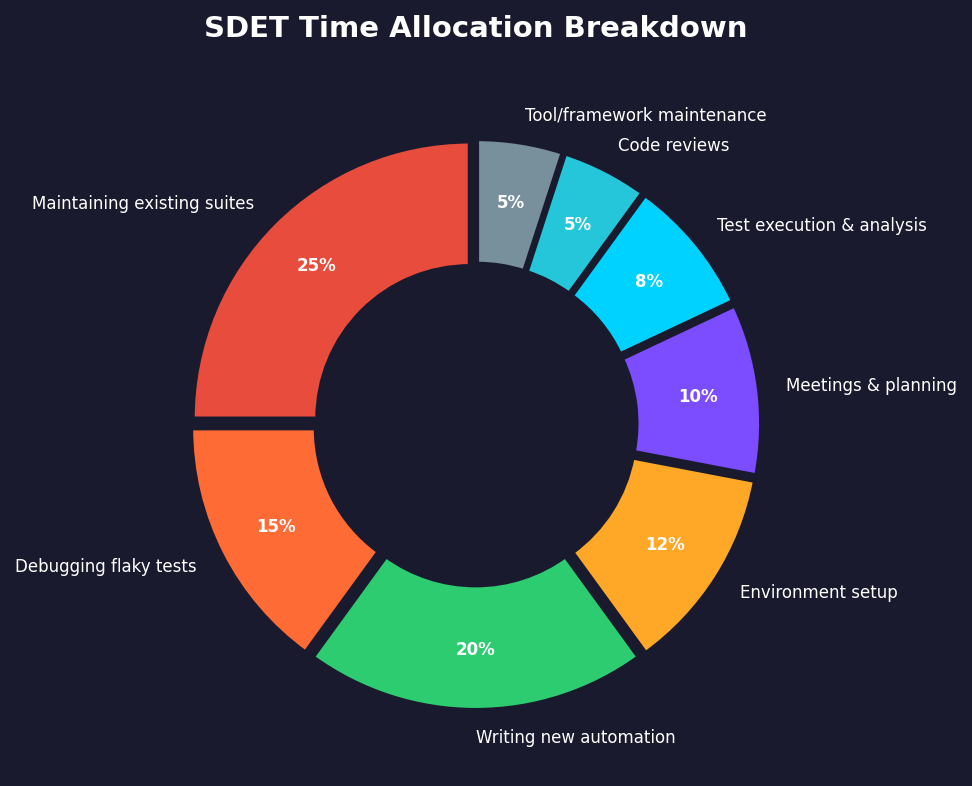
Read that again. Writing new test automation -- the thing SDETs are primarily hired for -- accounts for roughly one-fifth of the working week. Everything else is support work, coordination, or firefighting.
Why This Gap Exists
Three forces push SDETs away from their core work.
First, test suites grow but nobody budgets time for their upkeep. Every sprint adds new tests. Rarely does a sprint include a line item for refactoring old ones. Over months, the suite accumulates duplication, brittle locators, hard-coded waits, and tests that were written for a UI that has since been redesigned. Someone has to maintain all of that. That someone is the SDET.
Second, flaky tests are treated as annoyances instead of systemic problems. The Stack Overflow Developer Survey 2023 highlighted that developers frequently cite unreliable tests as a source of frustration. When a test fails intermittently, the typical response is "just re-run it." But someone still has to investigate why it is flaky, especially when the team starts ignoring failures because they assume everything is just flaky. That erosion of trust in the test suite is dangerous, and the SDET is usually the one trying to hold the line.
Third, environment instability is an underappreciated time sink. The Capgemini World Quality Report has consistently identified test environment availability as a top-three challenge for quality teams. SDETs lose hours to Docker containers that will not spin up, staging databases that are out of sync, third-party service sandboxes that are rate-limited, and CI runners that run out of disk space.
The Expectation vs. Reality Gap
Here is a comparison that tends to resonate with anyone who has lived in this role.
What SDETs Are Hired to Do vs. What They Actually Do
| Expectation (Job Description) | Reality (Typical Week) |
| Build new automated test frameworks | Patch and maintain existing frameworks |
| Write automated test cases for features | Rewrite tests broken by UI/API changes |
| Improve test coverage | Triage flaky test failures in CI |
| Integrate tests into CI/CD | Debug CI pipeline failures and environment issues |
| Evaluate and adopt new testing tools | Keep current tools from breaking |
| Mentor manual testers on automation | Attend sprint planning, retros, standups, demos |
| Analyze test results and report quality | Re-run failed suites and check if failures are real |
This is not to say the "reality" column is unimportant. Every item there is necessary work. The issue is that none of it appears on a roadmap, none of it is planned in sprint capacity, and all of it is invisible to leadership until test coverage stalls and someone asks "Why are we not automating faster?"
Key Insights From Working With SDET Teams
Flaky tests cost more than you think
A single flaky test does not just waste the five minutes it takes to re-run. It triggers an investigation. The SDET checks recent commits, reviews the test logic, runs it locally, checks the environment, and sometimes concludes "it was just timing." Multiply that by the 10-15 flaky tests that a mature suite accumulates, and you are looking at 4-6 hours per week -- sometimes more.
Environment work is invisible work
Setting up test environments, resetting test data, configuring service mocks, and troubleshooting infrastructure is work that rarely shows up in sprint boards. But from conversations with QA teams across companies -- including work I have been involved in at TestKase -- this category alone can consume an entire day each week for SDETs on complex products.
Meetings scale with team size, not with need
SDETs on a single scrum team might spend 4-5 hours per week in ceremonies. SDETs who support multiple teams (common in platform or shared-services models) can spend 8-10 hours per week in standups, refinements, and planning sessions that overlap. That is an entire day gone.
Data and Statistics
Note: The following figures are illustrative estimates based on industry trends and published reports. They are not sourced from a single proprietary dataset.
| Metric | Estimate |
| Average % of SDET time on new test creation | 15-25% |
| Average hours/week spent on flaky test debugging | 4-6 hours |
| Teams reporting environment issues as a top blocker | 52% (Capgemini WQR 2023-24) |
| SDETs reporting insufficient time for test design | ~60% (industry surveys) |
| Average test suite maintenance burden growth/year | 15-20% |
The Capgemini World Quality Report 2023-24 specifically noted that "insufficient test environments" and "lack of time" were among the most frequently cited challenges by QA and testing professionals. The DORA (DevOps Research and Assessment) State of DevOps Reports have repeatedly linked test reliability to deployment frequency -- teams with flaky test suites deploy less often, creating a measurable business impact.
Actionable Recommendations
Here are concrete steps for SDETs and engineering managers to close the expectation-reality gap.
For SDETs
Track your time for two weeks. Not in a tool -- just a notepad. Write down what you actually worked on in 30-minute blocks. The data will surprise you and give you ammunition for conversations with your manager.
Quarantine flaky tests aggressively. Move them to a non-blocking suite. Fix them in dedicated maintenance sprints. Do not let them erode trust in your main pipeline.
Automate your environment setup. If you are spending more than 30 minutes a week on environment issues, invest in containerized setups, seed scripts, and documented runbooks. The upfront cost pays back within a month.
Say no to meetings that do not need you. If you are invited to three teams' refinements but only actively contribute to one, propose async updates for the other two.
For Engineering Managers
Budget maintenance time explicitly. Allocate 15-20% of SDET capacity to test suite maintenance every sprint. If you do not plan it, it will happen anyway -- it just will not be visible.
Measure flaky test rate and treat it as a quality metric. If more than 5% of your test runs include a flaky failure, that is a systemic problem, not a test problem.
Invest in environment reliability before asking for more coverage. Adding more tests on top of an unreliable environment just means more failures to investigate.
Audit meeting load quarterly. Count the hours your SDETs spend in ceremonies. If it exceeds 15% of their week, restructure.
Comparison: Immature vs. Mature SDET Time Allocation
| Activity | Immature Team | Mature Team |
| Writing new test automation | 15% | 35% |
| Maintaining existing tests | 30% | 15% |
| Debugging flaky tests | 20% | 5% |
| Environment setup/troubleshooting | 15% | 5% |
| Meetings and planning | 10% | 10% |
| Test execution and analysis | 5% | 15% |
| Code reviews | 3% | 10% |
| Tool/framework maintenance | 2% | 5% |
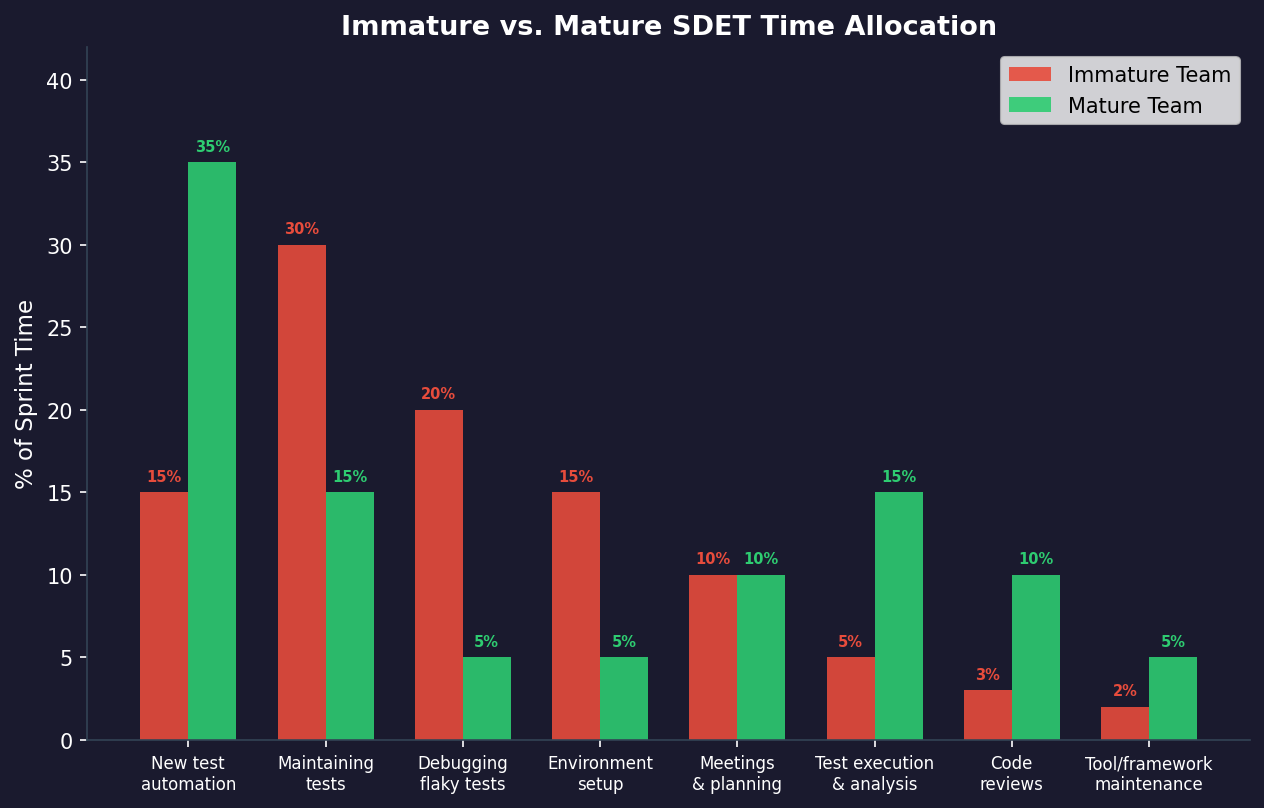
The shift from immature to mature is not about working harder. It is about investing in infrastructure, enforcing test hygiene, and treating the test suite as a product that needs its own maintenance roadmap.
FAQ
Q: What percentage of their time should SDETs spend writing new tests? A: A healthy target is 30-40%. If your SDETs are below 20%, maintenance debt and environmental issues are likely consuming too much of their capacity. Track it for two weeks to get a baseline.
Q: How do I reduce flaky test debugging time? A: Start by quarantining known flaky tests into a separate non-blocking suite. Then dedicate one sprint per quarter to a "flake fix" effort. Track flaky test rate as a team metric and make it visible in retrospectives.
Q: Should SDETs attend all scrum ceremonies? A: SDETs should attend standups and sprint planning for teams they directly support. For other ceremonies, async summaries or optional attendance works better. The goal is to keep meeting load under 15% of their week.
Q: Is test maintenance a sign of poor initial test design? A: Partly, but not entirely. Even well-designed tests need updates when the product changes. The real issue is when maintenance is not planned for. Treating test suites as "write once, run forever" is the mistake -- not the original test quality.
Q: How can engineering managers make SDET time allocation visible? A: Use work-type tags in your project management tool. Tag tasks as "new automation," "maintenance," "flaky fix," "environment," and "framework." After two sprints, you will have enough data to see the real distribution and have an informed conversation about where to invest.
Conclusion
The SDET role carries an expectation of building. But the reality of the job, especially in organizations that have not deliberately invested in test infrastructure and process hygiene, is that most of the week goes to maintaining, debugging, and firefighting.
This is not a failure of the individual SDET. It is a structural problem. Test suites grow without maintenance budgets. Environments break without reliability investments. Meeting calendars fill without audits.
The fix starts with visibility. Track where the time actually goes. Then make deliberate, planned investments in the areas that steal the most hours: flaky test reduction, environment stability, and meeting hygiene.
When you give SDETs back even five hours a week of productive building time, the impact on test coverage, release confidence, and team morale compounds quickly. That is not theory -- it is what happens every time a team takes this seriously.
About the Author
Naina Garg is an AI-Driven SDET at TestKase, an AI-powered test management platform. She writes about quality engineering, test management, and the realities of building software that ships with confidence.


