How Test Maintenance Debt Silently Breaks Your Pipeline

Your CI/CD pipeline looks green, but underneath, outdated and flaky tests are quietly draining your team's velocity. Here's how test maintenance debt builds up and what you can do about it.
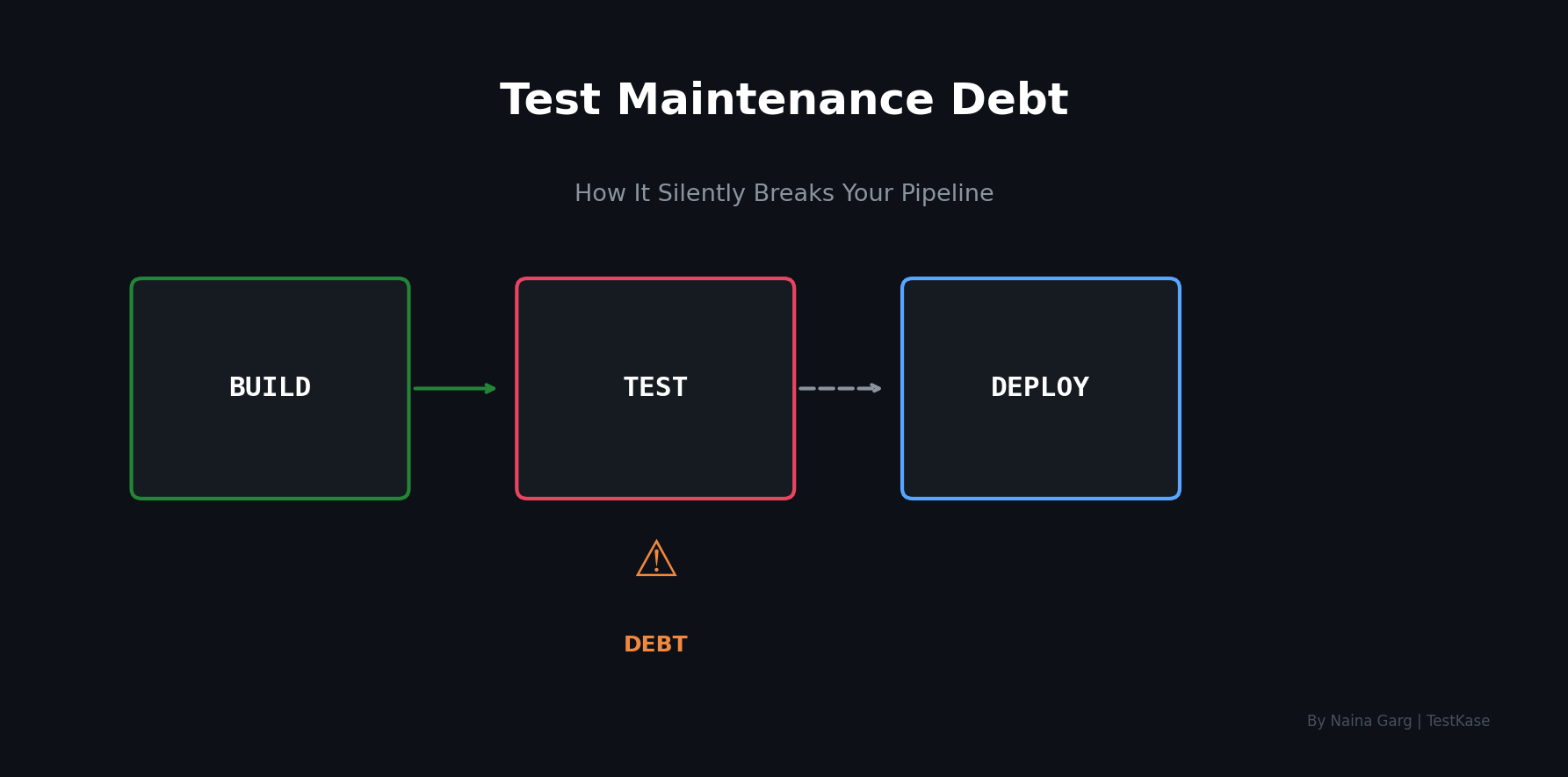
Quick Answer
Test maintenance debt is the hidden cost of neglected, outdated, or flaky automated tests that pile up over time. It slows your CI/CD pipeline, erodes developer trust, and eventually forces teams to skip tests altogether. The fix is not writing more tests — it is building a sustainable practice around reviewing, pruning, and updating the ones you already have.
Top 3 Key Takeaways
- Flaky and outdated tests cost more than no tests. False positives train your team to ignore failures, defeating the purpose of automation.
- Maintenance debt compounds silently. Broken tests rarely trigger alerts — they just sit there, wasting compute and eroding confidence.
- Prevention beats cleanup. Scheduled audits, ownership tagging, and retirement policies keep debt from snowballing.
TL;DR
Your test suite is probably bigger than it needs to be. A good chunk of it is either flaky, redundant, or testing something that no longer exists. That is test maintenance debt. It makes your pipeline slower, your results less trustworthy, and your developers less willing to write tests. Regular audits, clear ownership, and smart tooling keep your pipeline honest and fast.
Introduction
You shipped a feature last Tuesday. The pipeline ran. Tests passed. Everything looked fine.
Then QA found a bug in production.
You go back and check. The test that should have caught it had been broken for three months — marked as "skipped." The test that did run? It was validating a flow redesigned two sprints ago.
This is test maintenance debt. It does not announce itself. It creeps in — one skipped test here, one outdated assertion there — until your test suite becomes a liability instead of a safety net.
If your team has ever said "just ignore that test, it's been flaky for weeks," you already have this problem.
What Is Test Maintenance Debt?
Test maintenance debt is the accumulated cost of tests that are no longer accurate, relevant, or reliable. Think of it like technical debt, but specifically for your test suite.
It shows up in several forms:
- Flaky tests that pass sometimes and fail others, with no code change in between
- Orphaned tests that cover features or flows that have been removed or redesigned
- Brittle tests tightly coupled to implementation details instead of behavior
- Duplicated tests that check the same thing multiple ways, adding execution time without adding coverage
- Skipped tests that someone disabled "temporarily" six months ago
Each of these individually seems harmless. Together, they form a drag on your pipeline that gets worse every sprint.
Why Test Maintenance Debt Builds Up
Nobody sets out to create maintenance debt. It happens because of normal engineering pressures:
1. Speed over sustainability. Deadlines push teams to write tests that pass code review, not tests that last six months.
2. No ownership model. If nobody owns a test, nobody updates it. Tests written by someone who left the team just sit there, decaying.
3. Feature churn. Agile teams ship fast. The UI changes, APIs shift, data models evolve. Tests written against last month's reality become lies this month.
4. Fear of deleting. Removing a test feels risky. So teams keep everything, and the suite bloats.
5. No audit process. Code gets reviewed. But who reviews whether existing tests are still valid? Almost nobody.
How It Breaks Your Pipeline
The damage is gradual, which is what makes it dangerous.
Slower feedback loops. A bloated suite turns a 10-minute pipeline into 40 minutes. Developers stop waiting and merge anyway.
False confidence. Green builds with broken tests are meaningless. You think you have coverage, but you have gaps dressed as checkmarks.
Alert fatigue. Flaky failures train the team to ignore all failures — including real ones.
Developer resistance. Nobody adds tests to a suite they do not trust.
Wasted compute. Redundant and orphaned tests burn CI minutes. At scale, that is real money.
Who Gets Hit Hardest — Demographics Breakdown
By Role
| Role | Primary Impact | Common Response |
| SDET / QA Engineer | 40-60% of time spent fixing flaky tests | Skips or disables tests to keep pipeline moving |
| Developer | Loses trust in test results | Merges without waiting for CI |
| Engineering Manager | Slower velocity, unclear cause | Adds headcount instead of fixing process |
| DevOps / Platform | Pipeline times balloon; costs climb | Throws hardware at the problem |
| Product Owner | Release dates slip | Pressures team to cut testing, worsening debt |
By Company Size
| Company Size | Debt Level | Key Challenge |
| Startup (1-20 eng) | Low-moderate | No formal test process; debt forms early |
| Mid-size (20-100 eng) | High | Growth outpaces governance; no coordination across teams |
| Enterprise (100+ eng) | Very high | Legacy suites nobody understands; resistance to cleanup |
Where Does Pipeline Time Actually Go?
When teams audit their test suites, the breakdown of wasted time is often surprising.
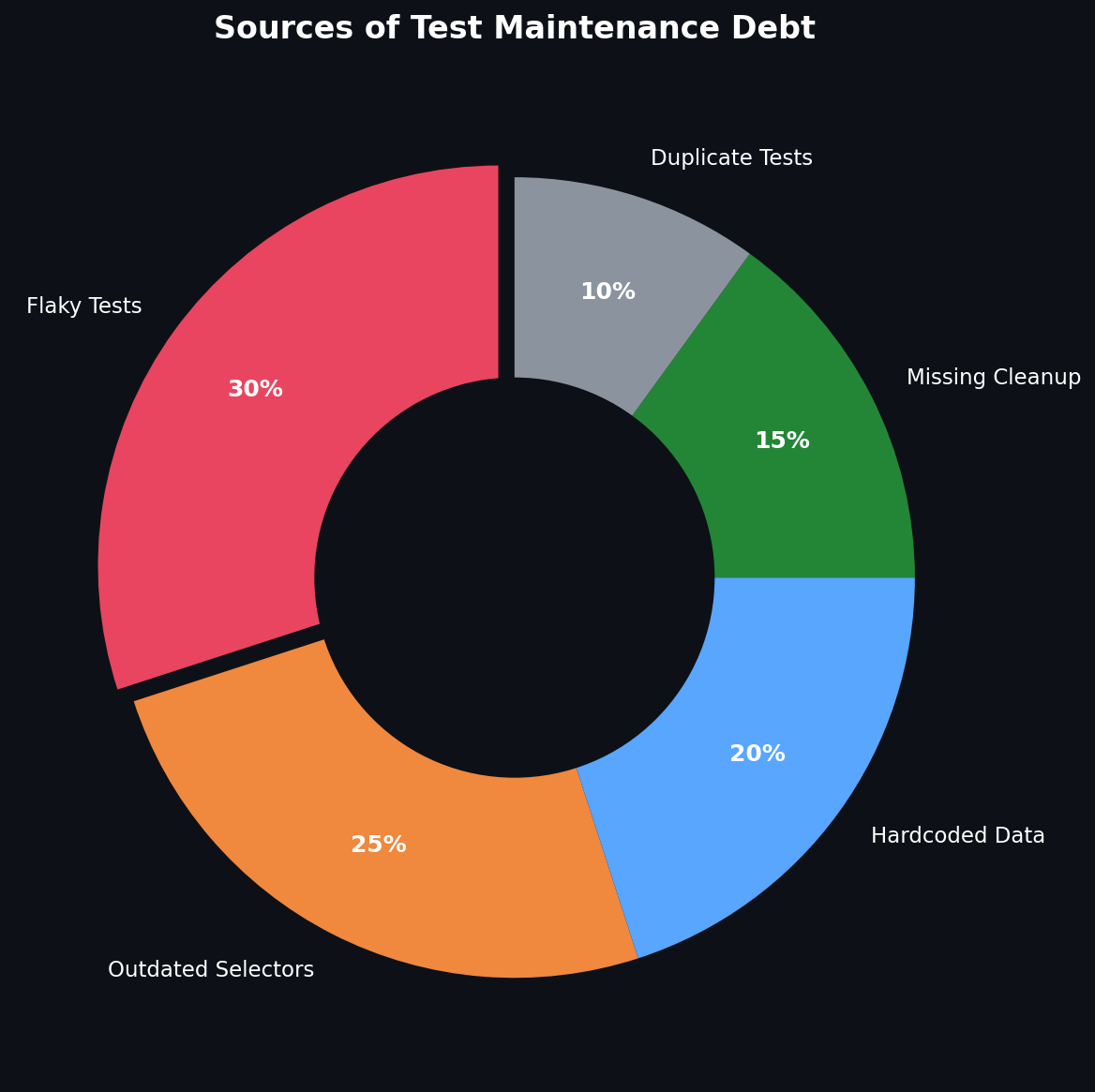
Fallback Table (if chart does not render):
| Debt Type | % of Wasted Pipeline Time |
| Flaky Test Retries | 35% |
| Redundant Test Execution | 25% |
| Investigating False Failures | 20% |
| Orphaned Test Runs | 12% |
| Skipped Test Triage | 8% |
Flaky test retries alone eat over a third of wasted pipeline time.
Comparison: Maintained vs. Unmaintained Test Suites
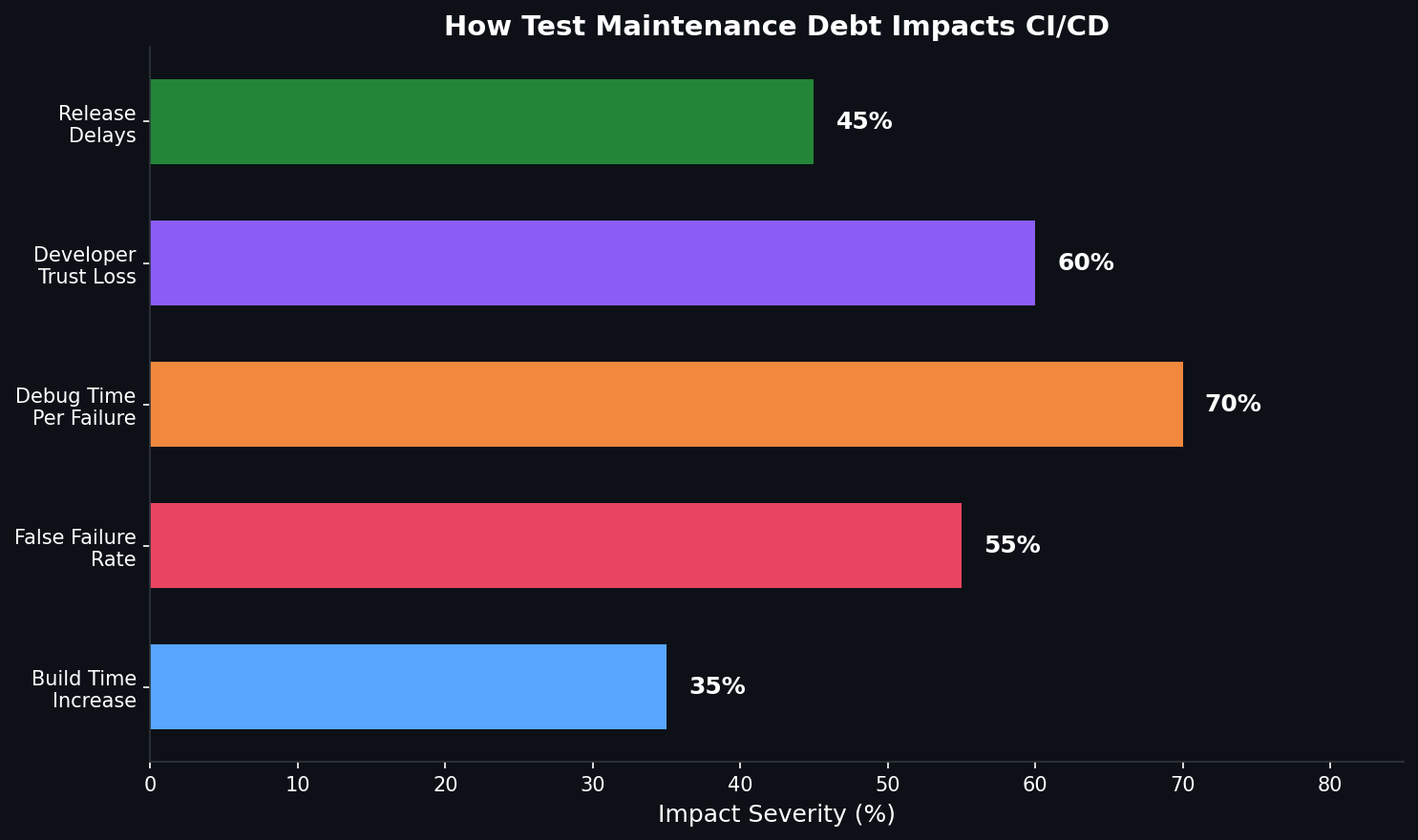
| Metric | Maintained Suite | Unmaintained Suite |
| Pipeline Duration | 8-15 min | 30-60+ min |
| Flaky Test Rate | Under 2% | 15-30% |
| Developer Trust | High — tests are a safety net | Low — tests are a chore |
| False Failure Rate | Rare | Multiple times per week |
| Test-to-Feature Ratio | Intentional and lean | Bloated with orphans |
| Mean Time to Detect Bugs | Minutes | Hours to days (if at all) |
| CI Costs (monthly) | Predictable | 2-4x higher than necessary |
This gap builds sprint by sprint, and it narrows only with deliberate effort.
Expert Analysis
Shift from coverage quantity to quality. Teams are moving from "we need 80% coverage" to "we need meaningful coverage of critical paths." High numbers with flaky tests are worse than moderate coverage with reliable ones.
Test observability is emerging. Teams now track flakiness rate, execution time trends, and failure-to-fix latency. Platforms like TestKase are part of this shift toward treating test management as a first-class engineering concern rather than an afterthought.
Ownership is the biggest lever. Teams that assign clear ownership of test modules consistently report lower maintenance debt than teams that treat tests as communal property.
FAQ
How do I know if my team has test maintenance debt?
Look for: pipeline times growing steadily, a list of "known flaky" tests everyone ignores, skipped tests nobody can explain, and developers merging before CI finishes. If two or more are true, you have debt.
Should I delete old tests?
Yes, but audit first. If a test covers a removed feature, delete it. If it is flaky, fix or rewrite it. If it duplicates another test, remove the weaker one.
How often should we audit our test suite?
At minimum, once per quarter. Ideally, review flaky test trends and skipped test counts every two weeks during sprint planning.
Can automation fix test maintenance debt?
Partially. Automated flakiness detection and coverage mapping surface problems faster. But deciding what to fix, delete, or rewrite still requires human judgment.
Actionable Recommendations
Here are five steps you can take this week:
Run a flaky test audit. Pull your CI logs from the last 30 days. Identify every test that failed at least once without a corresponding code change. Rank them by frequency. Fix or quarantine the top 5.
Tag every test with an owner. Add metadata or comments indicating which team or person owns each test module. Unowned tests are the first to rot.
Set a "skipped test" policy. Any test that has been skipped for more than 30 days should be either fixed or deleted. Put this in your team agreement and enforce it.
Track suite execution time as a metric. Add pipeline duration to your team dashboard. If it trends up by more than 10% in a quarter without a proportional increase in features, you have a debt problem.
Schedule quarterly test pruning. Block two hours every quarter for the team to review and clean up the test suite together. Treat it like a code cleanup sprint — because it is one.
Conclusion
Test maintenance debt never feels urgent until it is expensive. Your pipeline slows down gradually. Trust erodes one flaky test at a time. By the time someone asks "why does CI take 45 minutes?" the debt has been compounding for months.
The fix is not complicated — it is just consistent. Audit regularly. Own your tests. Delete what is dead. Fix what is flaky. Your CI/CD pipeline is only as strong as the tests it runs. Make sure those tests are worth running.
About the Author
Naina Garg is an AI-Driven SDET at TestKase, where she works on intelligent test management and quality engineering practices. She writes about the intersection of AI, test automation, and sustainable QA processes for modern engineering teams.


